
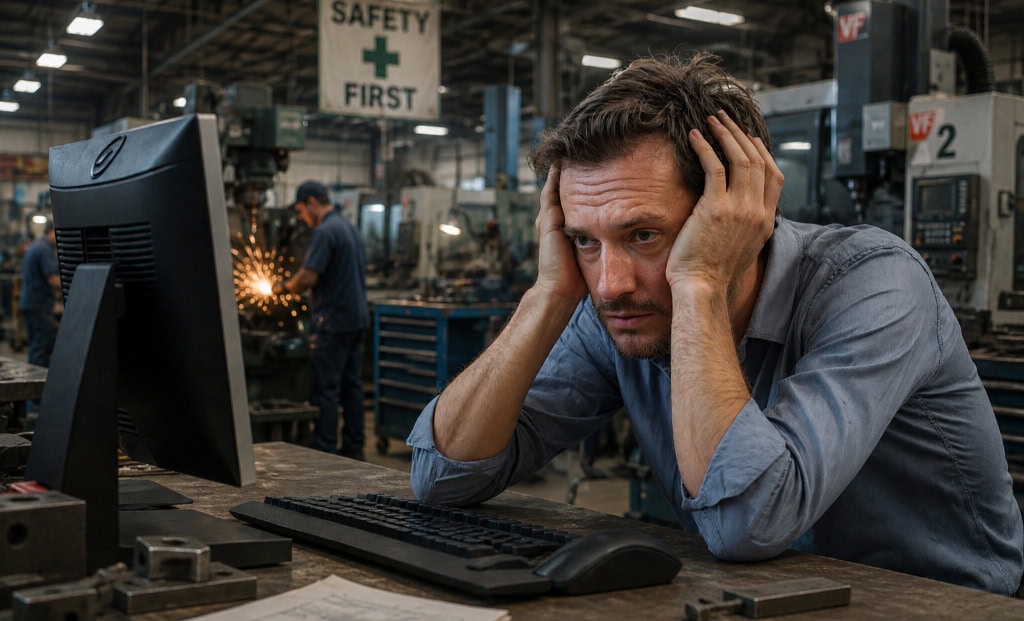
For a small fabrication job shop, survival and growth depend on agility. You juggle custom quotes, fluctuating material costs, unpredictable lead times, and a shop floor where priorities can shift by the hour.
In the beginning, a mix of spreadsheets, whiteboards, and tribal knowledge is usually enough to keep the doors open. But as business picks up, that duct-tape-and-string system starts to fray. You hear about Enterprise Resource Planning (ERP) software, but it sounds massive, expensive, and frankly, like a headache meant for giant manufacturers.
So, when exactly do you cross the line from “we’re managing just fine” to “we absolutely need an ERP”?
It’s rarely about a specific revenue number or employee count. Instead, readiness is defined by operational friction. Here are the unmistakable signs that your job shop is ready for an ERP.
The “Tribal Knowledge” Bottleneck
If your shop floor grinds to a halt because one specific estimator, shop foreman, or veteran welder takes a sick day, you have a scalability problem.
When a business is small, it’s easy for one person to keep track of every job in their head. But as your order volume grows, that mental data silo becomes a massive risk.
You are ready for an ERP when you need a single source of truth. In this system, routing steps, material specs, and customer history are digitized and accessible to everyone in real-time, instantly.
Estimating or ‘Guesstimating’?
For a fabrication shop, winning a bid is only half the battle; winning it profitably is what keeps you in business.
The Red Flag: You are losing quoting bids because your quotes are too high, or worse, you’re winning bids only to realize after final welding and assembly that you actually lost money on the job.
If you can’t easily track actual material usage and labor time against your initial estimates, you are flying blind.
An ERP gives you job costing accuracy by tying purchasing, inventory, and shop-floor time directly to the job number. If you need to stop guessing and start knowing your margins, you’re ready.
The “Where is Order #402?” Scavenger Hunt
When a customer calls asking for a status update, what happens?
Do you have to put them on hold, walk out to the shop floor, track down the supervisor, who then goes through his traveler or notepad for the status?
In a custom job shop, parts move from cutting to bending, welding, machining, and finishing. Without an ERP, tracking this flow is chaotic.
You are ready for an ERP when you need real-time shop floor visibility. You should be able to look at a screen and see exactly which work center a job is currently sitting at and whether it’s on schedule.
Inventory is Either “Ghost” or “Glut”
Inventory management in fabrication is tricky. Steel prices fluctuate, and drops (leftover material) accumulate.
The Ghost: You think you have a sheet of 1/4″ plate in stock, but when the operator goes to grab it, it’s gone. Production stops.
The Glut: Because you don’t trust your inventory counts, you over-buy material, tying up precious cash flow in racks of metal you won’t use for months or never use at all.
An ERP with robust inventory and Material Requirements Planning (MRP) modules tracks allocations in real-time. It knows what’s on hand, what’s already promised to a live job, and what needs to be ordered.
Don’t Wait for the Crash
Many small job shop owners look at an ERP as a reward for when they get “big.” The reality? An ERP is the tool that allows you to grow in the first place.
If you wait until your shop is completely overwhelmed by chaos, implementing a new software system will feel like trying to change the tires on a truck while driving 70 mph down the highway. The exact moment you are ready is when the pain of your current administrative chaos outweighs the perceived pain of adopting a new system.
Look for an ERP specifically designed for job shops and make-to-order manufacturers, not a generic system meant for repetitive assembly lines. Start small, focus on solving your biggest bottleneck first (whether that’s quoting, scheduling, or inventory), and build a foundation that lets your craftsmanship shine without the chaos.
Our highly experienced ERP expert, Greg Bennett, discusses the right time to implement an ERP system and the common challenges manufacturers face without one.
Still confused about when to go for an ERP for your shop?
Take the ERP Readiness Evaluation Test Today.
Already made up your mind? Get in touch with us for a demo.


4 Responses
Just exploring your services
Interested in Ai ERP
This was actually more useful than I expected. The points about ERP integration were especially interesting.
The point about starting small resonates. We went through a similar hesitation before deciding to move, worried about change fatigue on top of everything else already in flux. What tipped it for us was realizing the alternative wasn’t “no change,” it was slower, messier change through manual workarounds that get harder to unwind every month. Starting with Finance and Inventory first, rather than a full rollout, made the whole decision less binary. For anyone weighing the same choice, this comparison of ERP software options is a useful reference for what a phased approach can look like in practice.