
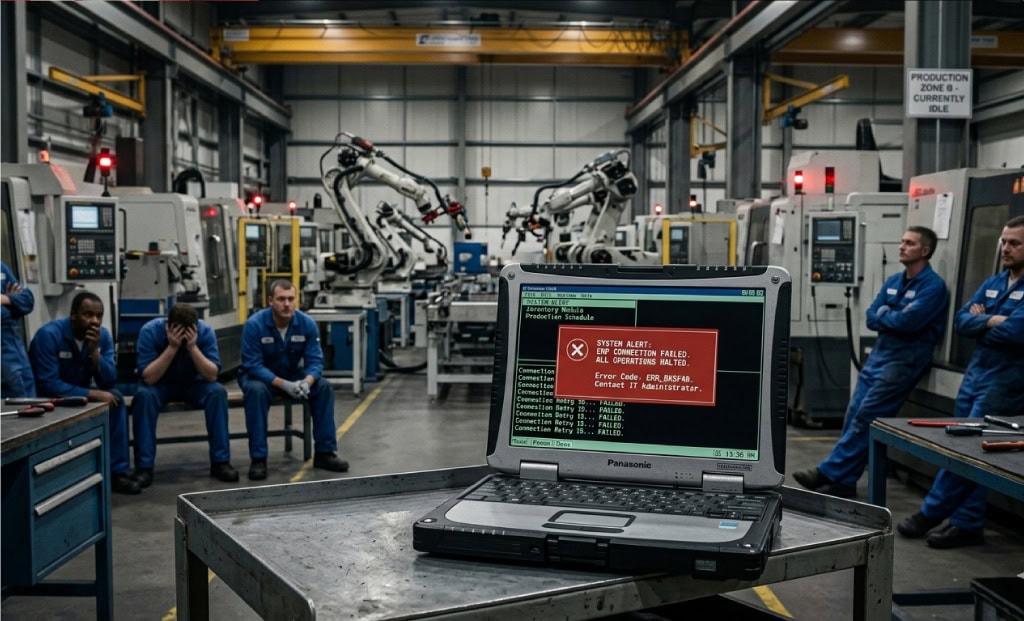
Agility isn’t just a buzzword in modern manufacturing; it is a survival mechanism and the means to growth and scalability.
Yet, many manufacturers remain shackled to ‘legacy’ or rigid ERP/MRP systems. These systems were designed for a simpler era of manufacturing and with a ‘one size fits all’ approach. They were built for stability but not for growth.
Today, these systems become huge bottlenecks that stifle growth in complex production environments.
Here is why legacy ERPs are failing today’s manufacturers who still use them.
Change is the only Constant
Complex manufacturing, such as aerospace and defense, medical devices, industrial machinery, and engineer-to-order manufacturing, never follows the conventional processes. Engineering changes happen mid-production, thereby having a cascading impact from design to production. Customer specifications keep evolving, and manufacturers have no choice but to incorporate them into the final product seamlessly.
It’s like changing the wheels of a car when it’s in motion.
Legacy ERPs were built on linear logic. When a variable changes at any point in a manufacturing process, it gets very difficult to incorporate it, as they often require exhaustive manual workarounds to adapt.
If your software can’t pivot as fast as your shop floor does, you aren’t losing time; you are losing data integrity.
The ‘Shadow IT’ Explosion
When an ERP is very difficult to customize, difficult to use and adapt to, frustrated employees turn to the path of least resistance – Spreadsheets and siloed tools/applications.
In complex manufacturing, rigid ERP systems lack the granular visibility needed for intricate production scheduling, multi-level Bill of Materials (BoM) management or product configuration. As a result, critical data trickles into spreadsheets and third-party apps from the ERP, diluting the overall data pool.
Data silos form, where the ‘truth’ on the ERP doesn’t match the ‘truth’ on the floor, leading to costly procurement errors, production delays and missed deadlines.
High Cost of ‘Customization’ vs. ‘Configuration’
There is a huge difference between a system that is configurable and one that requires customization to meet manufacturing needs.
Rigid ERP systems require expensive consultants and code-heavy changes to alter a single workflow. Every software update risks breaking fragile customizations built over the years, risking operational disruption.
Modern ERPs use low-code development and selective customization to adapt to quick requirement changes without rewriting the core ERP engine.
Complex manufacturers have to pay a huge ‘customization tax’ if they are using a rigid ERP system. This scares them into submission, and they do not upgrade their ERPs, rendering their systems perpetually obsolete.
Innovation Paralysis
Industry 4.0 defines modern manufacturing today. IoT sensors, robots, AI-driven operations and real-time data are the backbone of today’s manufacturing. Legacy ERPs simply lack the API capability required to talk to these new technologies. They act like a closed fortress, preventing the seamless flow of data across the entire manufacturing enterprise.
Even if they manage to create a link between the legacy ERPs and these technologies at a high cost and manpower, it becomes a pack of cards that can crumble anytime because of a simple bug fix or a software update.
Integrate to Disintegrate
When it comes to integrating with third-party or internal applications, legacy ERPs throw a fit and go into a shell. Again, the lack of APIs and the need to hard-code every bit of change into the ERP make it very difficult to integrate it with external applications.
Conclusion
In a complex manufacturing environment, your ERP should be your enterprise’s nervous system – instantly responsive, interconnected and adaptive.
If your existing ERP feels more like a straitjacket for your business, it’s time to look towards modular, cloud-native platforms that offer flexibility and customizability.
Time to throw rigid ERPs out of the window, because when the operational pressure is too much, they don’t bend, they break.
Meet OmegaCube ERP! A highly flexible, customizable, modern ERP solution for your manufacturing or distribution business.
- Adapts to your business workflows and processes
- Extensive integration and customization capabilities
- Cloud or On-premise deployment
- Low-code development and API compatibility
Contact us for a live demo



4 Responses
Just exploring your services
Interested in Ai ERP
This was actually more useful than I expected. The points about ERP integration were especially interesting.
The point about starting small resonates. We went through a similar hesitation before deciding to move, worried about change fatigue on top of everything else already in flux. What tipped it for us was realizing the alternative wasn’t “no change,” it was slower, messier change through manual workarounds that get harder to unwind every month. Starting with Finance and Inventory first, rather than a full rollout, made the whole decision less binary. For anyone weighing the same choice, this comparison of ERP software options is a useful reference for what a phased approach can look like in practice.