
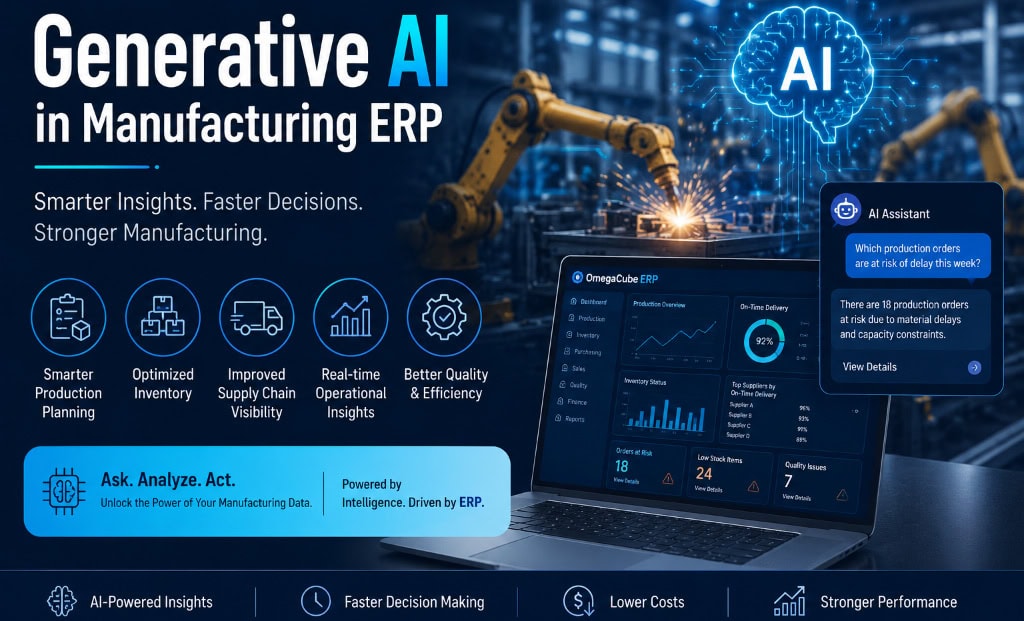
Manufacturers generate an enormous amount of data every day, from production schedules and inventory transactions to machine performance, quality records, purchase orders, and customer demand. Yet, much of this valuable information remains underutilized because it’s difficult to access, analyze, and act quickly, especially with legacy systems, manual methods and spreadsheets.
Generative AI, along with Manufacturing ERP, is changing that.
By integrating Generative AI with a manufacturing ERP system, manufacturers can transition from generating reports and dashboards to quickly accessing actionable insights and making quick, informed decisions.
What is Generative AI in Manufacturing ERP?
Generative AI in Manufacturing ERP is the use of artificial intelligence (AI) to analyze ERP data, answer natural language questions, automate reporting, and support faster business decisions across manufacturing operations.
Instead of navigating multiple dashboards or manually compiling reports, users can simply ask questions such as:
- Which production orders are at risk of missing their due dates?
- Why has machine utilization dropped this week?
- Which orders are ad hoc or emergency orders?
- Which purchased materials are delaying production?
- What inventory items are likely to become excess stock?
- What inventory items require replenishment?
- Which customers generate the highest profit margins?
Within seconds, AI can analyze ERP data and deliver accurate, meaningful answers.
Why Manufacturers Are Embracing AI-Powered ERP
Manufacturing operations are becoming increasingly complex. Global supply chain disruptions, fluctuating demand, labor shortages, and rising production costs require businesses to make decisions faster than ever before.
Generative AI helps manufacturers by:
- Accelerating decision-making
- Reducing manual reporting and errors
- Improving operational visibility
- Identifying production risks earlier
- Supporting continuous improvement initiatives
Rather than replacing employees, AI empowers production managers, planners, buyers, and executives with instant access to advanced business intelligence.
Practical Applications of Generative AI in a Manufacturing ERP
Smarter Production Planning
Production planners spend hours reviewing schedules, material availability, and machine capacity.
With Generative AI, they can instantly identify:
- Production bottlenecks
- Capacity constraints
- Delayed work orders
- Material shortages
- Recommended schedule adjustments
This enables faster scheduling decisions while improving on-time delivery.
Intelligent Inventory Insights
Inventory is one of the largest investments for manufacturers.
AI can analyze inventory trends and answer,
- Which items are slow-moving?
- Which materials are overstocked?
- What inventory is approaching obsolescence?
- Which purchased parts require replenishment?
Instead of searching through multiple reports and dashboards, users receive immediate, data-driven recommendations.
Quicker Root Cause Analysis
When production issues occur, manufacturers need answers quickly.
Generative AI can correlate information across production, purchasing, inventory, quality, and maintenance to identify likely causes of:
- Production delays
- Quality issues
- Material shortages
- Supplier performance problems
This significantly reduces troubleshooting time.
Executive Decision Support
Manufacturing leaders need concise, actionable insights, not multiple pages of reports.
AI-generated summaries can provide:
- Daily production performance
- Inventory health
- Customer delivery risks
- Revenue trends
- Purchasing performance
- KPI exceptions
Executives spend less time gathering data and more time making strategic decisions.
Better Shop Floor Visibility
Shop floor supervisors can use AI to quickly understand:
- Which jobs require immediate attention
- Which machines are underutilized
- Which production orders are behind schedule
- Labor performance trends
- Quality exceptions
This allows supervisors to respond proactively instead of reactively.
Benefits of Generative AI + ERP
An ERP already provides manufacturers with a centralized platform for managing production, inventory, purchasing, scheduling, warehousing, finance, quality, and customer relationships. Generative AI enhances this foundation by making ERP data easier to access and interpret.
Imagine asking the ERP:
“Show me the top five production bottlenecks impacting this week’s shipments.”
Or:
“Summarize inventory items with less than 30 days of demand.”
Or:
“Which customer orders are at risk due to supplier delays?”
Instead of manually generating reports, users receive clear, conversational answers backed by real-time ERP data.
Generative AI creates value for every department.
| Production Improve scheduling decisions Reduce production delays Increase throughput | Supply Chain Monitor supplier performance Identify material shortages Improve procurement planning |
| Inventory Management Reduce excess inventory Improve inventory accuracy Minimize stockouts | Quality Detect recurring quality issues Identify production trends Support corrective actions |
| For Executives Faster business insights Simplified reporting Better strategic planning |
The Human Advantage Remains
While Generative AI can analyze large volumes of information in seconds, experienced manufacturing professionals remain at the center of every decision.
AI serves as an intelligent assistant, surfacing insights, highlighting risks, and reducing the time spent searching for information. The expertise of planners, supervisors, engineers, and executives is still essential for evaluating recommendations and making sound operational decisions.
The Future of Manufacturing ERP
The next generation of ERP systems such as OmegaCube ERP will do more than store information; they’ll help interpret it.
Manufacturers that embrace AI-powered OmegaCube ERP will be better equipped to respond to disruptions, improve efficiency, and make confident decisions based on real-time operational data.
By combining the robust capabilities of OmegaCube ERP with Generative AI, manufacturers can unlock faster insights, streamline workflows, and create a more agile, data-driven operation.
Ready to Build a Smarter Manufacturing Operation?
OmegaCube ERP helps manufacturers unify planning, production, inventory, warehousing, quality, finance, and business intelligence in one integrated platform. As AI capabilities continue to evolve, manufacturers using a connected ERP foundation will be well positioned to take advantage of intelligent automation and data-driven decision support.
Frequently Asked Questions
Generative AI in Enterprise Resource Planning (ERP) combines the power of artificial intelligence with business management software to help users interact with ERP data using natural language. Instead of manually searching through reports or dashboards, users can ask questions, generate summaries, automate routine tasks, and receive actionable insights in seconds.
AI helps manufacturers make production planning faster, smarter, and more proactive by analyzing large volumes of operational data such as customer demand, material availability, machine capacity, labor resources and delivery deadlines in real time and providing actionable recommendations.
Yes. AI can significantly reduce inventory costs by
- Analyzing inventory levels, slow moving and obsolete inventory
- Predict stock shortages and recommend timely replenishment
- Analyze historical trends, seasonal and customer order patterns to improve demand forecasting
- Monitor supplier performance to anticipate delays
- Automate inventory insights enabling quick decisions
No. AI is not replacing ERP systems, it is making them more intelligent.
An ERP system remains the operational backbone of a manufacturing business, managing critical processes such as production planning, inventory, purchasing, finance, quality, warehouse management, and customer orders. AI complements these capabilities by helping users analyze data, automate routine tasks, and make faster, more informed decisions.
Without an ERP system, AI has no reliable source of structured, real-time business information. Likewise, an ERP without AI may require users to spend more time searching for reports, identifying trends, and manually analyzing data.
Absolutely. Small and mid-sized manufacturers can leverage AI to improve efficiency, reduce costs, and make smarter business decisions, especially when it’s integrated with a manufacturing ERP solution like OmegaCube ERP.
Discover how OmegaCube ERP can help your organization transform manufacturing operations, today and into the future.



4 Responses
Just exploring your services
Interested in Ai ERP
This was actually more useful than I expected. The points about ERP integration were especially interesting.
The point about starting small resonates. We went through a similar hesitation before deciding to move, worried about change fatigue on top of everything else already in flux. What tipped it for us was realizing the alternative wasn’t “no change,” it was slower, messier change through manual workarounds that get harder to unwind every month. Starting with Finance and Inventory first, rather than a full rollout, made the whole decision less binary. For anyone weighing the same choice, this comparison of ERP software options is a useful reference for what a phased approach can look like in practice.