
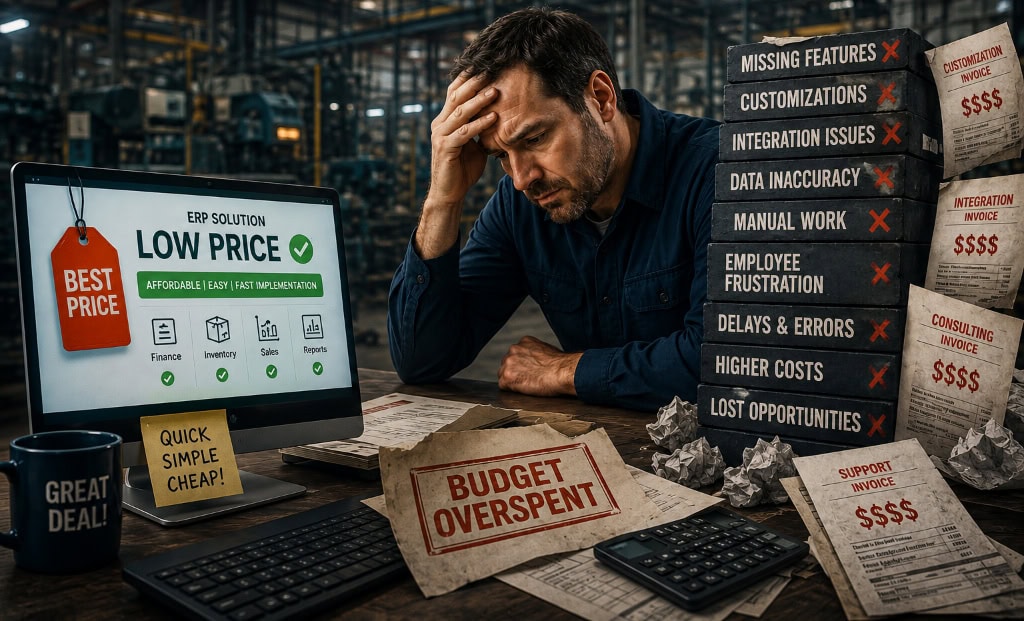
Why Does Cheap ERP Software Look Attractive?
Every manufacturing business reaches a point where spreadsheets become chaotic, production schedules start slipping, inventory goes missing, and customer expectations continue to rise. That’s when the management decides it’s finally time to invest in an ERP system.
For most manufacturers, the search begins with one question:
“How much does it cost?”
For many manufacturers, the lowest-priced ERP solution immediately grabs attention. The sales presentation is impressive, the implementation timeline seems short, and licensing costs are significantly lower than those of competing products.
It seems like a quick and easy decision. Until reality sets in.
Meet John: A Growing Manufacturer
John owns a growing precision machining company.
Business is good. Orders are increasing. New customers are coming in. But his existing systems are struggling to keep up.
He evaluates several ERP solutions.
One vendor demonstrates advanced scheduling, engineering change management, quality tracking, inventory forecasting, production planning, mobility features, low-code development and customization, and advanced integration capabilities. All this with swift implementation and support services.
Another vendor promises nearly everything, for almost half the price.
John thinks, “Why spend twice as much for features we’ll probably never use?”
He signs the contract. For the first few weeks, everything appears to be going well.
Then the problems begin.
The Hidden Costs of Cheap ERP
During implementation, John discovers that many capabilities he assumed were included are actually unavailable and have to be purchased separately under a different subscription plan, which is a lot higher than he is paying right now. There are some custom requirements too that are very expensive.
His production manager asks:
- Can the new system handle multi-level Bills of Materials?
- Can we schedule work centers based on machine capacity?
- Can we track serial numbers?
- Can engineering revisions automatically update production orders?
- Can we manage subcontract operations?
- Can we view work-in-progress in real time?
The answer becomes painfully familiar.
“Not out of the box.”
Or worse:
“That requires customization.”
Manufacturing isn’t like Other Businesses
Many low-cost ERP systems are designed for general business operations.
Manufacturing, however, is an entirely different challenge.
A true manufacturing ERP must coordinate dozens of interconnected processes such as,
- Production planning
- Material Requirements Planning (MRP)
- Shop floor management
- Inventory control
- Sales
- Purchasing
- Quality management
- Engineering changes
- Capacity planning
- Cost tracking
- Shipping
- Customer service
When even one of these processes isn’t supported properly, employees create workarounds. Soon, spreadsheets return, whiteboards and travelers come back, and sticky notes appear on machines.
Departments stop trusting the ERP.
How Hidden Costs Impact ROI
Ironically, the “cheap” ERP becomes increasingly expensive.
John now pays for:
- Third-party software to fill functionality gaps
- Custom programming
- Additional consultants
- Manual data entry
- Duplicate work
- Employee overtime
- Production delays
- Inventory inaccuracies
- Customer complaints
The money he saved on licensing disappears within the first year.
Employee Frustration Reaches a Breaking Point
Instead of making work easier, the ERP becomes another obstacle.
Production supervisors stop using it, warehouse staff create their own inventory spreadsheets, the accounting department spends hours correcting transactions, the sales team cannot create accurate quotations or promise delivery dates, and the management loses confidence in the reports because nobody trusts the data.
The ERP has become little more than an expensive record-keeping system.
Growth Creates Even Bigger Problems
As John’s company grows, new requirements emerge.
A major customer requests barcode tracking, another wants lot traceability, and a new aerospace contract requires quality documentation.
The existing ERP can’t support these capabilities without significant redevelopment.
Now John faces another difficult decision:
Spend heavily to customize an already limited ERP.
Or replace it entirely.
Neither option is inexpensive.
Buyer’s Remorse Sets In
Looking back, John realizes he focused on the wrong number.
He compared purchase prices, never calculated ownership costs, overlooked implementation and ERP adoption complexity and severely underestimated future growth.
Most importantly, he assumed every ERP is the same and could handle manufacturing equally well.
It couldn’t.
What Manufacturers Should Evaluate Instead of Price
Price matters, but it should never be the deciding factor.
Instead, manufacturers should ask:
- Does the ERP support our manufacturing processes today?
- Can it adapt to our business and grow with it?
- How much customization will we need?
- Is manufacturing the vendor’s core expertise?
- How many manufacturers like us use this solution?
- What is the total cost over five to ten years?
- How responsive is the implementation and support team?
The answers to these questions often reveal far more value than the initial price tag.
The Right ERP Isn’t the Cheapest, It’s the One That Fits
The best ERP isn’t necessarily the most expensive. Nor is it the cheapest.
It’s the solution that aligns with the way your manufacturing business actually operates.
An ERP should reduce complexity, not create it.
It should eliminate spreadsheets, not force employees back to them.
It should support growth, not limit it.
And it should provide long-term value, not short-term savings that turn into long-term costs.
Conclusion
Every manufacturer wants to control costs.
But choosing an ERP based solely on the lowest price can become one of the most expensive business decisions you’ll ever make.
Before signing the contract, ask one final question:
“Are we buying software because it’s affordable or because it’s the right solution for our manufacturing business?”
That answer could save your company years of frustration, and hundreds of thousands of dollars.
Frequently Asked Questions (FAQs)
Not always. While a low upfront price may seem attractive, many manufacturers spend significantly more later on customization, consulting, third-party and internal integrations, and manual work.
Hidden costs include implementation, employee training, custom development, integrations, additional licensing, maintenance, downtime, and productivity loss.
Manufacturers should evaluate:
- · Manufacturing capabilities
- · Scalability
- · Total Cost of Ownership
- · Vendor expertise
- · Support quality
- · Implementation methodology
- · Industry experience
Manufacturing ERP manages production planning, MRP, inventory, quality, engineering, scheduling, purchasing, costing, and shop floor operations, capabilities often missing in generic ERP systems.
Avoid costly ERP mistakes before they happen. Talk to our manufacturing ERP specialists for a personalized consultation and discover how the right ERP can streamline production, improve visibility, and support your long-term growth.



4 Responses
Just exploring your services
Interested in Ai ERP
This was actually more useful than I expected. The points about ERP integration were especially interesting.
The point about starting small resonates. We went through a similar hesitation before deciding to move, worried about change fatigue on top of everything else already in flux. What tipped it for us was realizing the alternative wasn’t “no change,” it was slower, messier change through manual workarounds that get harder to unwind every month. Starting with Finance and Inventory first, rather than a full rollout, made the whole decision less binary. For anyone weighing the same choice, this comparison of ERP software options is a useful reference for what a phased approach can look like in practice.