
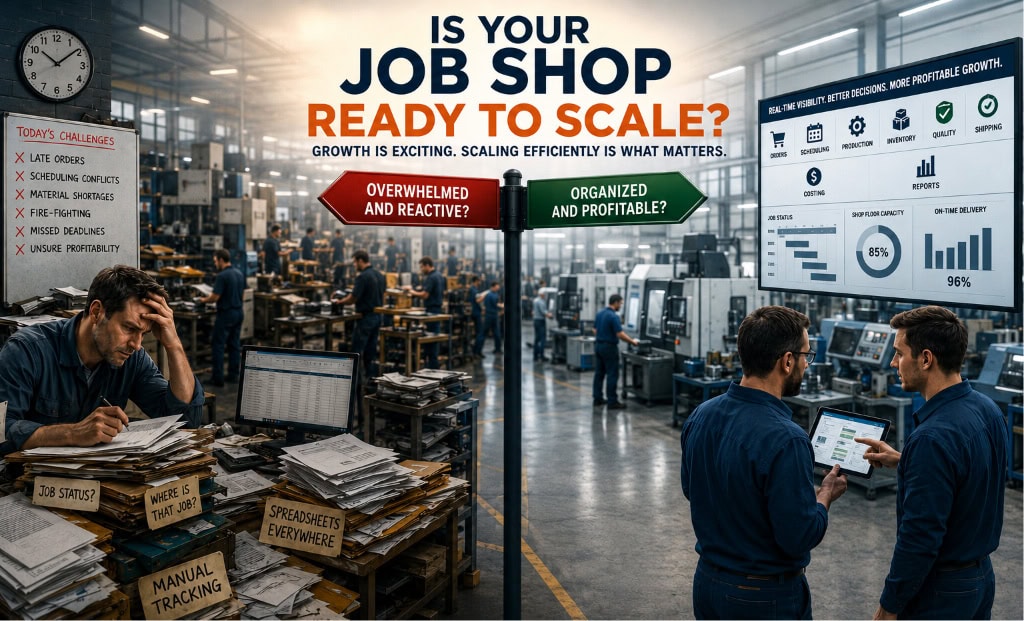
Growth is exciting for any job shop. More orders, new customers, and larger contracts are clear signs of success. But growth can also expose weaknesses in processes that worked perfectly when the business was smaller.
The real question isn’t simply
“Can we get more orders?”
It’s “Can our job shop handle more orders efficiently and profitably?”
If you have asked yourself the 2nd question, then it’s time to find out whether your job shop is ready to scale. Let’s find out.
1. Your Order Volume Is Growing Faster Than Your Processes
More orders mean longer production queues, scheduling conflicts, growing WIP and missed/delayed delivery dates. If your team is constantly firefighting to keep up, your processes may need to evolve.
2. Scheduling Has Become a Daily Challenge
As jobs increase, managing machines, material, labor, customer priorities and delivery dates becomes cumbersome and complicated. Constantly juggling overlapping orders, reshuffling schedules and calling the shop floor for constant updates are signs that you need better, real-time visibility into capacity and production.
3. You’re Turning Down Profitable Work
If you are hesitant to take up new business that is profitable because you don’t know if your shop has the capacity and can fulfil it, you may be leaving revenue on the table. Better capacity planning can help prevent this and identify hidden production capacity.
4. Too Much Knowledge Lives in People’s Heads
If you, as an owner and a few experienced employees, are the only people who know which machine, employee or process can handle a job, your manufacturing business may struggle to scale. Growing job shops need ready, accessible information that is updated in real-time throughout the shop floor.
5. You’re Spending Too Much Time Tracking Jobs
If you constantly ask, “Where is that job?” or “What is the job status?”, then you are wasting valuable time. Management needs real-time visibility into job status, materials, labor, machine capacity, and expected completion dates.
6. Job Costing and Quoting Are Becoming Difficult
As your business grows, arriving at accurate job costing becomes critical to roll out accurate quotes in response to RFQs. If you are unsure about the true profitability of jobs, then you will constantly struggle to arrive at accurate quotes, allowing your competitors to beat you to it and win over your prospect customers.
7. Spreadsheets and Manual Methods are Multiplying
Spreadsheets and individual applications can be useful, but when scheduling, inventory, quoting, purchasing, production, and costing depend on separate files and applications, data becomes fragmented, and errors become harder to control.
8. Your Customers Expect More Visibility
As a job shop grows, customers often become more demanding. They are constantly asking for accurate job status, shipment updates and sometimes last-minute changes that can derail your already stressed production schedule.
If your team has to spend significant time gathering information before responding to customers, it’s a sign that your internal systems may not be keeping pace with your growth.
9. Inventory Is Becoming Harder to Control
More jobs typically mean more materials. Without real-time inventory visibility, you will deal with material shortages, excess inventory, duplicate purchases, expired/obsolete materials, and production delays.
The problem becomes especially challenging when the same material is required for multiple jobs.
10. Your Team Is Working Harder, But Productivity Isn’t Increasing
This is one of the most important signs. If your workforce is putting in more hours but you’re not seeing a proportional increase in output, something is preventing your operation from scaling efficiently. It can be due to poor scheduling, excessive setup time, material shortages, production bottlenecks, rework, poor communication, manual administration, etc.
Ask yourself, “Is It Time for a Manufacturing ERP?”
If several of these signs sound familiar, your job shop may be ready for an integrated manufacturing ERP.
An ERP such as OmegaCube ERP can connect quoting, sales, inventory, scheduling, production, quality, shipping, and accounting, giving your team the much-needed visibility to manage greater complexity.
Scaling isn’t about simply doing more work. It’s about taking on more work without proportionally increasing costs, confusion, and administrative effort.
If your job shop is growing, make sure your workflows and systems are ready to grow with it.
Frequently Asked Questions (FAQs)
Consider an ERP when spreadsheets and manual processes no longer provide reliable visibility into quoting, inventory, scheduling, production, costing, and job status.
Yes absolutely. A manufacturing ERP can help small job shops manage growing order volumes, improve visibility, reduce manual work, and scale without adding unnecessary complexity.
An ERP connects quoting, inventory, production, scheduling, purchasing, shipping, and accounting, helping job shops manage more orders efficiently.
Multiple spreadsheets, travelers, notepads and silo applications can create fragmented data, duplicate entries, errors, and limited visibility across production, inventory, purchasing, and costing.
OmegaCube ERP integrates quoting, sales, inventory, scheduling, production, quality, shipping, and accounting to provide the visibility needed to manage growth.
Ready to find out if your job shop is ready for its next stage of growth? Explore how a manufacturing ERP such as OmegaCube ERP can help you scale without adding unnecessary complexity.



4 Responses
Just exploring your services
Interested in Ai ERP
This was actually more useful than I expected. The points about ERP integration were especially interesting.
The point about starting small resonates. We went through a similar hesitation before deciding to move, worried about change fatigue on top of everything else already in flux. What tipped it for us was realizing the alternative wasn’t “no change,” it was slower, messier change through manual workarounds that get harder to unwind every month. Starting with Finance and Inventory first, rather than a full rollout, made the whole decision less binary. For anyone weighing the same choice, this comparison of ERP software options is a useful reference for what a phased approach can look like in practice.