
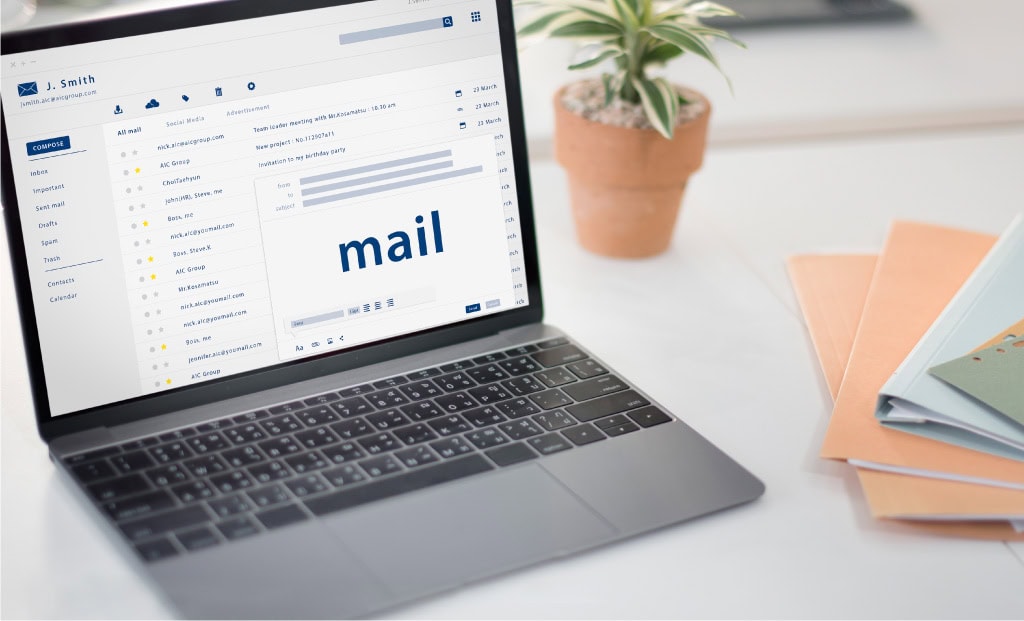
In many growing small and medium-sized manufacturing and distribution businesses, critical business conversations still live in individual inboxes.
Sales teams manage customer interactions via email in Outlook or Gmail; the support team tracks issues using separate tools; and the finance team handles billing queries using other tools.
The result? Fragmented, silo-based communication, missed follow-ups, missing data and limited visibility across departments.
An ERP’s built-in email module addresses this issue by serving as a single, centralized communication hub.
What are the key features of an email module within an ERP?
- Send emails using native software.
- Send reports, compliance documents, invoices, etc., from within the ERP
- Auto and user-configurable emailing of sales orders, purchase orders, and invoices, etc.
- Custom email templates and dynamic merges
- Attach documents from the ERP’s document repository or from the computer
- Automatic email logs and search capability
- Send emails from any supported device (mobile, tablets, etc.)
With the ERP’s email functionality, every internal and external interaction can be automatically linked to the relevant customer, invoice or project. It eliminates sifting through personal inboxes, notepads and documents, and teams/departments can view the entire communication history at a single location. This creates a single source of truth, eliminates confusion and miscommunication, and enables faster decision-making.
The benefits are immediate and measurable.
- Sales teams get better context with email history before reaching out to prospects.
- Customer service can resolve issues faster because they see prior conversations instantly.
- Finance teams can quickly reference billing discussions tied to specific invoices.
- Shop floor personnel can access instant alerts, notifications, work order inputs and send updates as necessary.
- The leadership team gets improved transparency into customer relationships and response times.
Business continuity is another major advantage. When employees change roles or leave the organization, valuable communication history doesn’t disappear with them. The ERP retains the complete email trail, protecting organizational knowledge and ensuring a smooth transition between personnel.
With an in-built email, manufacturers can achieve automation in communication. Manufacturers can trigger workflows based on incoming emails, send auto acknowledgements, alerts and notifications and track response metrics without manual effort. This improves efficiency and enhances customer experience through quick, consistent communication.
Conclusion
In today’s competitive, fast-moving manufacturing environment, disconnected inboxes and information create chaos, confusion and friction between teams and departments.
With an email-enabled ERP such as OmegaCube ERP, manufacturers break down communication siloes, improve collaboration and gain real-time visibility needed to serve customers efficiently and scale confidently.
In a nutshell, when conversations exist where your business data exists, everyone in the organization works smarter.



5 Responses
Just exploring your services
Non ut quae sit expedita adipisicing minima amet facilis possimus et quae nihil
Omnis deserunt ullam exercitationem temporibus
Voluptas quam Nam quis omnis eveniet voluptatem Doloribus dolore doloremque facilis voluptatem Quis veniam labore accusamus et
Corporis dolorem exercitationem quia neque obcaecati quo sed autem dolor