
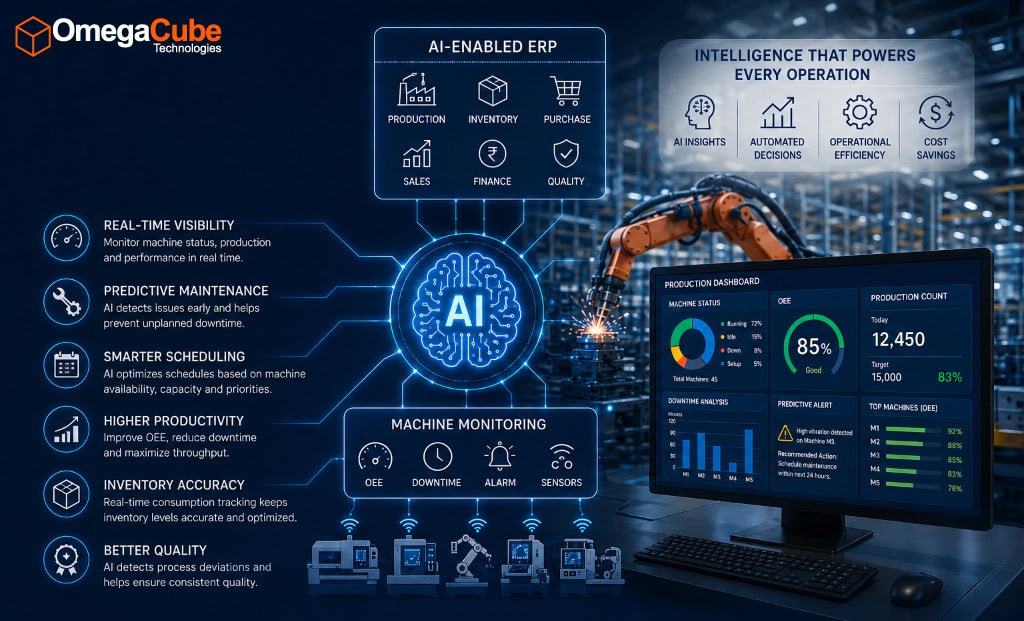
What modern manufacturers need today is to transform their enterprise into a smart factory environment where machines, people and business workflows operate together seamlessly.
All this is possible with a combination of Enterprise Resource Planning (ERP) software, Artificial Intelligence (AI) and Machine Monitoring systems.
What Is AI-Enabled ERP with Machine Monitoring?
AI-enabled ERP with machine monitoring integrates real-time machine data, artificial intelligence, and enterprise workflows to help manufacturers improve productivity, reduce downtime, and make faster decisions.
While the ERP software manages end-to-end enterprise operations, machine monitoring systems generate real-time operational data from the shop floor, and AI adds a punch by quickly converting this data into insights, enabling faster decision-making.
AI-enabled ERP combines traditional Enterprise Resource Planning capabilities with artificial intelligence and real-time machine monitoring data collected from:
- CNC machines
- PLCs
- Industrial IoT sensors
- Production equipment
- Assembly lines
- Packaging systems
- Robotics and automation systems
The ERP continuously receives live production data, while AI analyzes it to generate predictive insights, automate routine decisions, and improve operational efficiency.
Instead of relying solely on historical reports, manufacturers gain real-time visibility and intelligent recommendations for faster decision-making.
Why do Manufacturers Need This Integration?
Many manufacturers still face challenges such as:
- Unexpected machine downtime
- Inefficient production scheduling
- Manual production reporting
- Poor visibility into Overall Equipment Effectiveness (OEE)
- Delayed maintenance activities
- High scrap and rework rates
- Inaccurate production data
- Rising operational costs
An AI-enabled ERP with machine monitoring addresses these challenges by turning raw machine data into actionable business intelligence.
How the Integration Works?
| Machine Monitoring Collects Real-Time Data Machines continuously transmit information such as: > Machine status (Running, Idle, Breakdown) > Production count > Cycle time > Temperature > Vibration > Energy consumption > Downtime events > Alarm codes > Operator activity | ERP integrated with machines through machine monitoring system receives Production Data The ERP automatically updates: > Production orders > Work-in-progress > Inventory consumption > Finished goods > Production efficiency > Labor utilization > Scrap quantity > Operating time This eliminates manual data entry and improves data accuracy. | AI within the ERP Analyzes Operations AI processes the combined ERP and machine data to: > Predict equipment failures > Detect production bottlenecks > Recommend production schedule adjustments > Optimize machine utilization > Forecast maintenance requirements > Improve quality performance > Identify abnormal operating conditions |
Key Benefits of AI-Enabled ERP + Machine Monitoring
Predictive Maintenance
Rather than reacting to machine failures, AI identifies warning signs before equipment breaks down.
| AI analyzes: > Temperature trends > Vibration patterns > Machine cycles > Motor load > Historical maintenance records | The ERP can automatically: > Schedule maintenance work orders > Reserve spare parts > Notify maintenance teams > Update maintenance history | The Result: > Reduced downtime > Lower maintenance costs > Increased equipment life |
Intelligent Production Scheduling
Traditional scheduling relies on assumptions.
AI continuously evaluates:
- Machine availability
- Current workloads
- Equipment performance
- Labor and material availability
- Customer priorities
The ERP can automatically adjust production schedules when disruptions occur, helping minimize delays and maximize throughput.
Real-Time Production Visibility
Plant supervisors gain instant insight into:
- Live production status
- Machine utilization
- Downtime causes
- OEE performance
- Operator productivity
- Order completion progress
Interactive dashboards provide a real-time view of factory performance, enabling faster and more informed decision-making.
Improved Overall Equipment Effectiveness (OEE)
AI continuously monitors:
- Availability
- Performance
- Quality
It identifies the factors that reduce OEE and recommends corrective actions, helping manufacturers improve equipment productivity.
Quality Improvement
AI can detect patterns that often lead to defects, including:
- Machine drift
- Temperature fluctuations
- Tool wear and tear
- Abnormal cycle times
- Process deviations
The ERP can trigger quality inspections or corrective actions before defective products are produced.
Automated Inventory Updates
As machines complete production, the ERP automatically updates:
- Raw material consumption
- Work-in-progress
- Finished goods inventory
- Production completion
- Scrap quantities
This improves inventory accuracy and supports better planning.
Energy Monitoring and Cost Optimization
Machine monitoring systems capture real-time energy consumption data.
AI identifies:
- Energy-intensive equipment
- Idle machines consuming power
- Peak energy usage periods
- Opportunities to reduce operating costs
The ERP links energy usage to production costs, improving cost visibility.
Conclusion
AI-enabled ERP integrated with machine monitoring transforms manufacturing by connecting real-time shop floor data with enterprise-wide workflows and business processes. Instead of reacting to problems after they occur, manufacturers can easily predict, prevent, and optimize operations using intelligent insights.
By combining AI, machine monitoring, and ERP into a unified platform, manufacturers gain end-to-end visibility, smarter decision-making, improved productivity, and complete digitization of their enterprise operations, leading to your enterprise going the Industry 4.0 way.
Frequently Asked Questions (FAQs)
AI-enabled ERP is an ERP system that integrates Artificial Intelligence technologies such as machine learning, predictive analytics, natural language processing (NLP), and generative AI to automate processes, analyze large volumes of enterprise data, and provide quick, real-time, intelligent recommendations for better decision-making.
Machine monitoring systems (integrated with an ERP) collect real-time data from shop floor equipment, while the AI-enabled ERP transforms that data into actionable insights, automates workflows, and supports better business decisions.
Integrating AI-enabled ERP with machine monitoring helps manufacturers achieve:
- Real-time production visibility
- Reduced machine downtime
- Improved Overall Equipment Effectiveness (OEE)
- Better production planning
- Lower maintenance costs
- Higher inventory accuracy
- Faster decision-making
- Improved product quality
- Greater production efficiency
- Increased profitability
Instead of waiting for a machine to fail, AI monitors indicators such as:
- Vibration
- Temperature
- Motor load
- Machine cycles
- Historical maintenance records
When AI predicts an impending failure, the ERP can automatically:
- Create a maintenance work order
- Reserve spare parts
- Notify maintenance personnel
- Schedule repairs during planned downtime
This minimizes costly production interruptions.
Yes. By combining machine data with ERP information, AI continuously calculates:
- Machine availability
- Performance
- Yield Quality
The ERP provides dashboards that highlight losses and recommend actions to improve equipment effective
Manufacturing industries such as, metal fabrication, industrial machinery, aerospace and defense, automotive, medical equipment, electronics manufacturers, etc. use AI-enabled ERP integrated with machine monitoring.
OmegaCube ERP can be easily integrated with Machine Monitoring systems to easily track machine utilization, machine health, and determine Overall Equipment Effectiveness (OEE) by constantly monitoring machine data collected via machine controller devices.
To know more, join us for a 6-day exhibition of
- AI + ERP-led workflow automation
- Manufacturing digitization
- Improved efficiency and decision-making
With OmegaCube ERP
At IMTS 2026
September 14-19 | McCormick Place, Chicago, Illinois



3 Responses
Just exploring your services
Interested in Ai ERP
This was actually more useful than I expected. The points about ERP integration were especially interesting.